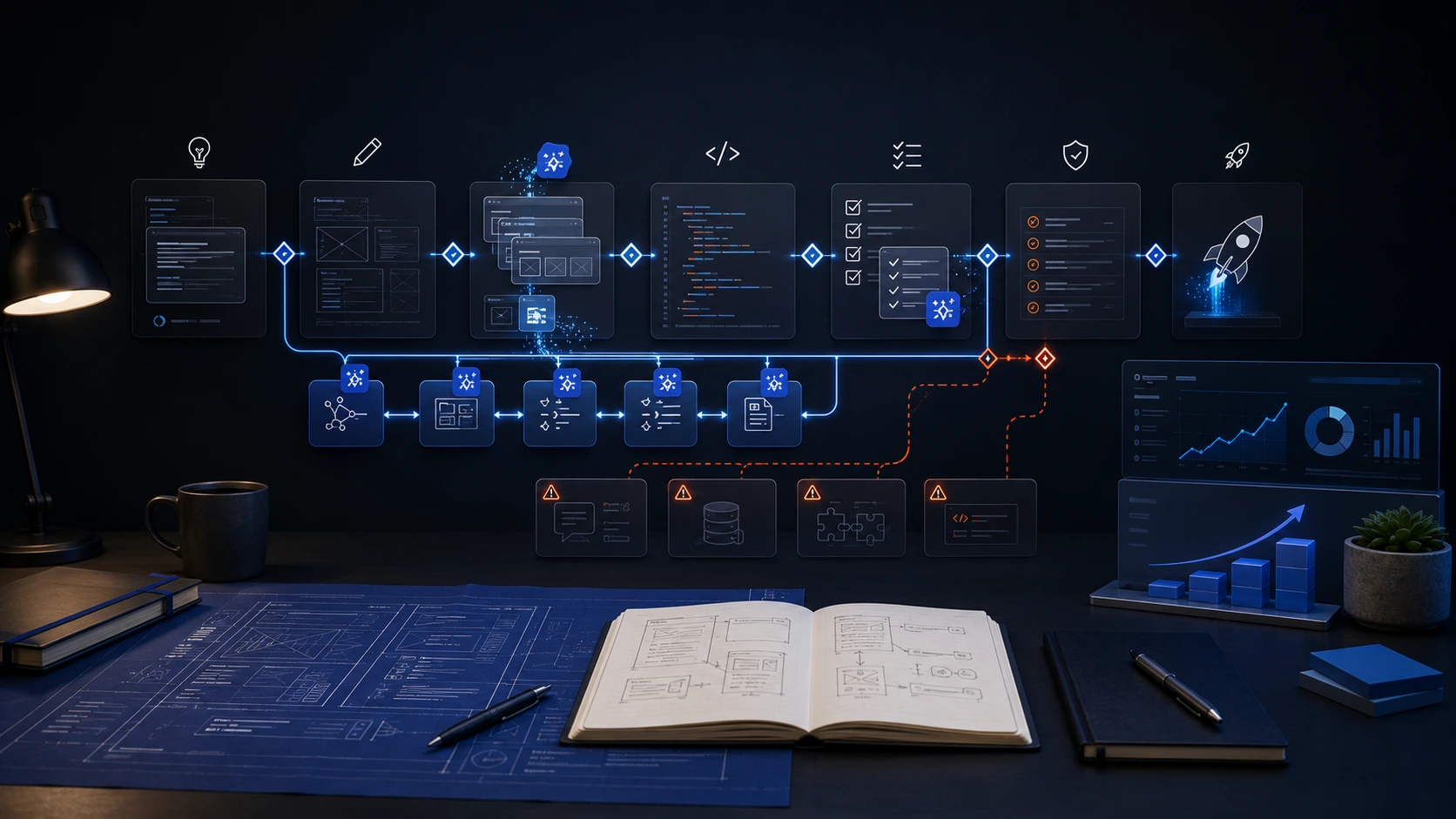
AI tools can significantly accelerate parts of digital product development. They can help teams analyse code, create standard components, write tests, investigate errors, and prepare documentation.
However, “twice as fast” does not mean that every project can automatically be delivered in half the time.
The result depends on:
- the quality of the requirements;
- product complexity;
- the condition of the existing codebase;
- team experience;
- architectural decisions;
- the number of integrations;
- security requirements;
- the process used to review AI-generated code.
AI accelerates specific parts of the workflow. If other stages remain bottlenecks, the overall project timeline may change very little.
What does “twice as fast” actually mean?
Acceleration should not be measured by the amount of code generated. It should be measured by the time between defining a task and delivering a working, verified result.
For example, a developer may use AI to build a component in one hour instead of two. But if the team then spends an additional day correcting mistakes, integrating the component, and repeating tests, the business has not gained meaningful speed.
It is therefore important to distinguish between:
- code-writing speed;
- task-completion speed;
- feature-delivery speed;
- the time required to launch the entire product.
A twofold improvement may be possible during specific stages or in certain types of projects. It is not a universal multiplier that can be applied to every project estimate.
Research also presents a mixed picture. In a controlled GitHub experiment, participants using Copilot completed a bounded programming task 55% faster. In contrast, a METR study involving experienced developers working in familiar open-source repositories found that early-2025 AI tools made them 19% slower. METR’s later data suggests that some speedup may now be occurring, but the estimate still has substantial statistical uncertainty. The practical effect depends on the task, team, and development process.
Where does AI genuinely accelerate development?
Research and requirements preparation
AI can help a team:
- structure an initial brief;
- identify contradictions in requirements;
- draft user journeys;
- prepare questions for the client;
- compare implementation approaches;
- convert meeting notes into a working document;
- identify possible edge cases.
This does not replace product analysis. Final decisions must still be made by people who understand the business, users, and project constraints.
The main benefit is turning unstructured information into something the team can review and challenge more quickly.
Prototypes and early interface versions
AI is useful for producing initial versions of:
- pages;
- forms;
- tables;
- cards;
- modal dialogs;
- empty states;
- responsive components;
- sample data.
This is particularly valuable when the team needs to test a user journey before investing in the final visual implementation.
However, the first generated interface is rarely production-ready. It must still be reviewed for design accuracy, accessibility, responsiveness, performance, and complete state coverage.
Standard implementation work
The largest gains often appear in repetitive, well-defined tasks:
- CRUD operations;
- forms and validation;
- data transformations;
- API clients;
- types and schemas;
- configuration files;
- repetitive migrations;
- standard administrative interfaces.
These tasks have outcomes that are relatively easy to describe and verify. The clearer the inputs and expected behaviour, the more useful the AI tool becomes.
Tests
AI can prepare initial versions of:
- unit tests;
- integration tests;
- test data;
- error scenarios;
- edge cases;
- validation checks.
A high number of tests does not automatically guarantee quality.
The team must still verify:
- whether the correct behaviour is being tested;
- whether the test simply repeats an incorrect implementation;
- whether critical scenarios are covered;
- whether permissions and security are tested;
- whether the tests create false confidence.
Refactoring and working with existing code
AI can assist with:
- explaining unfamiliar code;
- identifying duplicated logic;
- proposing decomposition;
- preparing a migration plan;
- updating a deprecated API;
- locating potentially unused functions;
- standardising repetitive files.
This can save substantial time in a small, well-structured module.
In a large legacy system, AI may misunderstand hidden dependencies. Major refactoring should therefore not be accepted without architectural review and behavioural verification.
Documentation
Documentation is often postponed when a team is focused on release.
AI can accelerate the preparation of:
- API descriptions;
- setup instructions;
- architectural notes;
- release notes;
- component documentation;
- internal procedures;
- initial user documentation.
An engineer must still verify the accuracy of the document. Editing a structured draft is usually easier than starting from a blank page.
Error investigation and initial diagnosis
An AI tool can analyse:
- an error message;
- a stack trace;
- related code;
- recent changes;
- possible causes;
- ways to test a hypothesis.
This can reduce initial investigation time, particularly for common technical problems.
The actual cause may still be located in business logic, data, infrastructure, or an external integration. Any proposed solution must be confirmed with a reproducible test.
Where does AI not replace an engineer?
Product decisions
AI can propose options, but it does not automatically know:
- which customer segment matters most;
- which business problem should be solved first;
- which feature customers are willing to pay for;
- what should be removed from the first release;
- which risks the company is prepared to accept.
Without these decisions, a team may simply build an unwanted product faster.
Architecture
Architectural decisions affect:
- future development cost;
- reliability;
- security;
- performance;
- scalability;
- maintenance complexity.
AI can help analyse alternatives, but responsibility for the decision must remain with an engineer who understands the complete system context.
Complex business logic
The more exceptions, roles, financial calculations, and internal rules a product contains, the more dangerous it is to accept generated code without careful analysis.
AI can create an implementation that appears logical but fails to account for a rare and critical scenario.
Security and access control
The following areas require particular care:
- authentication;
- authorisation;
- payments;
- personal data;
- file uploads;
- administrative functions;
- secrets and keys;
- audit logging.
Generated code should not be considered secure simply because it compiles and passes basic tests.
Final quality verification
AI can help write code and tests, but it should not independently approve the quality of its own work.
Confirming that a feature is ready requires:
- code review;
- automated checks;
- scenario testing;
- security verification;
- user-experience review;
- regression control.
Why does AI sometimes slow development down?
An unclear task
A long prompt does not solve a task that the developer does not understand.
AI will produce one plausible interpretation, and the team may then spend time rebuilding it.
The team should first define:
- the objective;
- constraints;
- expected behaviour;
- acceptance criteria;
- what must not be changed.
Insufficient context
The AI tool may not know:
- architectural conventions;
- business restrictions;
- the history behind previous decisions;
- infrastructure details;
- security requirements;
- hidden dependencies.
The less relevant context it receives, the more likely it is to produce convincing but unsuitable code.
Excessive code generation
Generating a large amount of code is easy. Reviewing it is considerably harder.
When a team measures productivity by lines generated, it may create:
- duplication;
- unnecessary abstractions;
- inconsistent solutions;
- technical debt;
- excessive review work;
- more potential defects.
The objective is not more code. It is less time to a reliable result.
Accepting output without understanding it
An AI answer may be confident, structured, and wrong.
The developer should understand:
- why the solution works;
- which assumptions were made;
- which scenarios are not covered;
- how the result can be verified;
- how the change can be safely reversed.
Too many tools
Using several AI models, agents, and automation layers at the same time does not necessarily improve speed.
The team may begin spending more time on:
- preparing different prompts;
- comparing responses;
- resolving conflicting solutions;
- managing context;
- coordinating tools.
One clear development workflow may be more effective than a complicated collection of AI systems.
What does faster development give the business?
Earlier market entry
When a team completes research, prototyping, and standard implementation faster, the product reaches real users sooner.
The business can receive earlier:
- customer feedback;
- initial enquiries;
- behavioural data;
- validation or rejection of the hypothesis;
- evidence for the next priority.
More iterations in the same period
The greatest benefit of AI is not always reducing a four-month project to two months.
It may be more valuable to use the same four months to:
- test more alternatives;
- improve the critical user journey;
- conduct additional interviews;
- resolve more issues;
- prepare stronger documentation.
Lower cost of repetitive work
AI can reduce the time specialists spend on repetitive operations.
This does not mean that a professional team can automatically be reduced by half.
The usual benefit is that the same specialists can spend more time on architecture, product decisions, quality, and difficult problems.
Faster reduction of uncertainty
For a new product, the greatest risk is often not the cost of writing code. It is spending months building the wrong solution.
When AI helps a team create and test a working prototype sooner, the business learns earlier:
- whether the market needs the product;
- whether the main journey is understandable;
- whether users are prepared to complete the target action;
- which features are genuinely important.
When is a twofold acceleration realistic?
Significant acceleration is more likely when:
- the first release has clear boundaries;
- requirements are sufficiently specific;
- the team uses a familiar, standard technology stack;
- the project contains substantial routine implementation;
- the team knows how to use AI tools effectively;
- the codebase is well structured;
- automated tests and checks are already configured;
- decisions are approved quickly;
- external integrations are well documented.
AI may, for example, significantly accelerate an internal portal, administrative interface, standard SaaS MVP, or corporate platform with well-defined workflows.
When is “twice as fast” unrealistic?
Acceleration will be limited when:
- the business has not decided what should be built;
- requirements change continuously;
- the project depends on complex legacy code;
- tests and documentation are missing;
- a novel algorithm must be researched;
- the product handles critical financial operations;
- many unstable integrations are required;
- decisions require lengthy approval;
- launch depends on content, licences, or external organisations.
AI does not remove organisational delays or make difficult product decisions on behalf of the business.
How should AI be introduced safely?
Choose specific use cases
Do not begin with the objective of “using AI everywhere”.
Choose a small number of tasks where the result is easy to verify:
- test generation;
- documentation;
- standard components;
- error analysis;
- small refactors;
- migration preparation.
Establish clear rules
The team should define:
- which data may be shared with a model;
- which tools are approved;
- who reviews the output;
- which parts of the system require mandatory manual review;
- which checks must pass before code is merged;
- how potential vulnerabilities are handled.
Measure the complete delivery cycle
Measuring only coding time is insufficient.
It is more useful to track:
- time from task definition to production;
- code-review duration;
- number of tasks returned for revision;
- defects identified after release;
- time spent correcting regressions;
- percentage of tasks delivered on schedule;
- documentation quality.
DORA describes AI as an amplifier of the existing system. Strong engineering practices help teams capture more value, while weak processes can produce more code without improving delivery speed or stability.
How should you evaluate a contractor’s proposal?
When an agency promises to build a product “twice as fast with AI”, ask:
- Which stages will be accelerated?
- Which work will remain manual?
- How will generated code be reviewed?
- Who is responsible for architecture and security?
- Which tests are included?
- How will the actual improvement be measured?
- What happens when an AI-generated solution is unsuitable?
- Will the client own all of the code?
- How will confidential data be protected?
- What is included in post-launch support?
An answer limited to “we use modern AI tools” does not demonstrate that the result will be faster or more reliable.
Conclusion
AI can substantially accelerate software development, but it does not automatically turn a complex product into a simple task.
It provides the greatest value when:
- the task is clearly defined;
- the result can be verified quickly;
- the workflow contains repetitive work;
- the team understands the architecture;
- testing and code review are established;
- AI is used as an engineering tool rather than a replacement for engineers.
The correct business objective is not to receive more code in less time. It is to obtain a working, verified product sooner and begin making decisions based on real usage data.
Discuss where AI can accelerate your project
Describe the product, current process, and primary result you want to achieve.
The Prodexa team will help you:
- identify tasks that can genuinely be accelerated;
- separate useful automation from unnecessary risk;
- define a realistic first release;
- estimate the timeline and budget;
- establish a development process with mandatory engineering review.
Need advice on your project?
Tell us about the task — we'll respond within a day.
Contact us