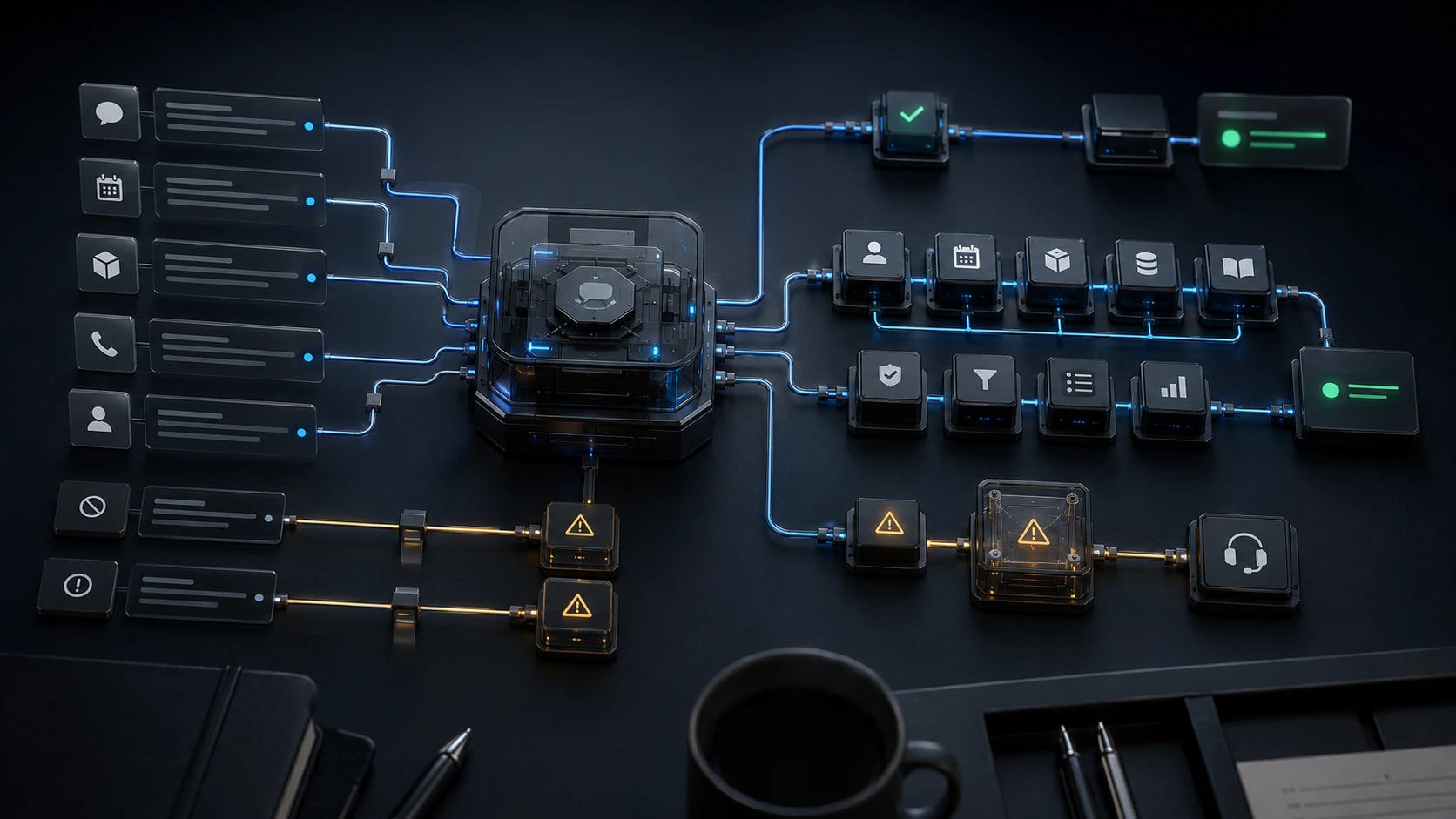
A chatbot can answer common questions, accept enquiries, book appointments, check order status, and transfer data into a CRM.
However, automation alone does not guarantee that the business will save money.
A good bot reduces waiting time, removes repetitive work from employees, and helps the customer complete a useful action sooner. A bad bot forces users through irrelevant menus, provides incorrect answers, and hides the option to contact a person.
The correct question is therefore not:
“Does the business need a chatbot?”
It is:
“Which specific process can be automated, what does it currently cost, and can a bot handle it without damaging the customer experience?”
The quick answer: when does a chatbot pay off?
A chatbot is more likely to be justified when several of the following conditions are true:
- the company receives a meaningful volume of repetitive enquiries;
- most questions have predictable answers;
- customers need a fast result;
- the required data is available in a CRM, catalogue, schedule, or another system;
- employees spend significant time on routine actions;
- complex cases can be transferred to a person;
- the result can be measured through cost, conversion, or processing time.
A chatbot is less likely to be justified when:
- enquiry volume is low;
- every case is unique;
- the sale requires detailed consultation;
- customers are dealing with emotionally sensitive situations;
- company information is disorganised or outdated;
- the bot is not connected to real business systems;
- automation is being used to hide a weak process.
What types of chatbot are available?
Rule-based chatbot
A rule-based chatbot follows predefined logic.
It presents buttons, asks questions in sequence, and moves the user through a fixed flow.
This type of bot works well when the available options are known in advance:
- selecting a service;
- booking an available time;
- answering frequently asked questions;
- collecting contact details;
- checking a status;
- initial qualification;
- creating an enquiry.
Its main advantage is predictability. It does not invent answers and performs only permitted actions.
Its limitation is low flexibility. When a user phrases the request differently or leaves the expected path, the bot may reach a dead end.
AI chatbot
An AI chatbot can interpret free-form language and generate responses using a model, an approved knowledge base, and connected tools.
It may:
- understand questions expressed in different ways;
- search company documents;
- explain complex terms;
- extract parameters from a message;
- classify an enquiry;
- prepare a response for an employee;
- perform approved actions through integrations.
An AI chatbot is more flexible, but it requires stronger controls.
It may:
- misinterpret the question;
- use outdated information;
- make an unsupported inference;
- produce a convincing but incorrect answer;
- perform an inappropriate action when system boundaries are poorly designed.
Hybrid chatbot
For most business use cases, a hybrid model is more practical.
It combines:
- natural-language understanding;
- an approved knowledge base;
- deterministic business rules;
- buttons and forms for critical actions;
- integrations with CRM and internal systems;
- mandatory human handoff for complex cases.
For example, AI may understand that the customer wants to reschedule an appointment. The actual change is then performed through a controlled flow that checks available times and asks the user to confirm.
Where does a chatbot create the most value?
Repetitive questions
Automation may be economically useful when employees answer the same questions every day.
Examples include:
- service scope and pricing;
- opening hours;
- location;
- delivery conditions;
- payment methods;
- required documents;
- return rules;
- order status;
- product availability.
A chatbot is particularly useful when answers come from one maintained source of truth.
When information is spread across spreadsheets, messages, and employee memory, the information should be organised before the bot is built.
Appointment booking
A bot may:
- identify the required service;
- display available times;
- collect contact details;
- create the booking;
- send confirmation;
- issue a reminder;
- allow rescheduling or cancellation.
The value is not limited to saving employee time. The customer can complete the action immediately without waiting for a response.
Order or enquiry status
Questions such as “Where is my order?” and “What is happening with my request?” create repetitive workload.
When connected to the real operating system, a bot may show:
- current status;
- expected completion date;
- next stage;
- a missing document;
- the responsible employee;
- the reason for a delay.
The underlying data must be reliable. When the internal system is not updated, the chatbot simply communicates incorrect information faster.
Initial qualification
Before connecting a sales representative, a bot may collect:
- task type;
- city;
- budget;
- deadline;
- company size;
- required service;
- contact details;
- additional context.
This allows the representative to begin with useful background information.
A long interrogation, however, reduces conversion. The bot should ask only for information that genuinely affects the next step.
Internal employee assistant
A chatbot does not need to be customer-facing.
An internal assistant may help employees:
- locate policies;
- find instructions;
- check product conditions;
- prepare responses;
- create internal requests;
- retrieve data from business systems;
- complete standard documents.
This is often a safer initial use case because an employee can verify the answer before it reaches a customer.
When does a chatbot damage the business?
Complex and emotional enquiries
Automation is poorly suited to situations where the customer:
- reports a serious problem;
- requests a refund;
- has suffered financial loss;
- is involved in a legal dispute;
- needs individual medical or financial guidance;
- expects empathy and accountability.
A bot may collect initial information, but it should not create another barrier before human support.
Complex sales processes
When a purchase requires diagnosis, trust, negotiation, and an individual proposal, a chatbot is unlikely to close the sale independently.
It may:
- explain basic conditions;
- answer initial questions;
- qualify the customer;
- recommend relevant material;
- schedule a consultation.
Replacing a strong sales representative with a long AI conversation may reduce conversion.
No reliable knowledge base
An AI bot does not repair poor information.
When documents:
- contradict one another;
- are outdated;
- have no responsible owner;
- are not separated by product or region;
- contain incomplete rules,
the bot scales the uncertainty.
Before launch, the business must define which sources are authoritative and who maintains them.
No human handoff
The user should understand:
- that they are interacting with an automated system;
- which tasks the bot can handle;
- how to reach an employee;
- when a human response can be expected.
A bot that repeats the same answer and provides no escalation is worse than a simple contact form.
Customer support is deliberately hidden
Some businesses introduce a bot not to help customers, but to reduce employee contact at any cost.
This creates:
- hidden contact information;
- endless menus;
- no way to describe an unusual issue;
- automatically closed conversations;
- loss of trust.
The bot’s purpose is to resolve simple questions faster and route complex cases correctly, not to block the customer.
How should return on investment be calculated?
A payback period cannot be determined without current operating numbers.
Begin by calculating the cost of the existing process.
Current cost
Estimate:
- monthly enquiry volume;
- percentage of repetitive enquiries;
- average handling time;
- fully loaded employee cost per hour;
- enquiries received outside working hours;
- unanswered or lost enquiries;
- cost of mistakes;
- current software expenses.
Chatbot cost
The estimate should cover more than initial development:
- research and design;
- conversation-flow creation;
- knowledge-base preparation;
- integrations;
- development;
- testing;
- infrastructure;
- message and API costs;
- support;
- monitoring;
- content updates;
- continued improvement.
Economic effect
The effect may include:
- reduced manual handling;
- faster response;
- lower peak-hour workload;
- additional enquiries outside working hours;
- fewer lost contacts;
- more completed bookings;
- faster sales representatives;
- fewer operational errors.
A simplified formula is:
Monthly effect = operating cost saved + additional gross profit − monthly chatbot cost.
Payback period = initial investment / monthly net effect.
Example calculation
Assume:
- the company receives 4,000 enquiries per month;
- 45% are repetitive;
- one repetitive enquiry takes four minutes;
- the fully loaded employee cost is $8 per hour;
- the bot completes 60% of suitable conversations;
- monthly infrastructure and support cost $500;
- development and implementation cost $12,000.
Potentially automated time:
4,000 × 45% × 60% × 4 minutes = 4,320 minutes, or 72 hours.
Direct labour saving:
72 × $8 = $576 per month.
When only labour cost is considered, the project produces almost no financial effect after monthly operating expenses.
The result may change if the bot also preserves sales outside working hours, reduces unanswered enquiries, or increases completed appointments.
This demonstrates why message volume alone is insufficient. The complete commercial outcome must be measured.
Which metrics should be monitored after launch?
Automated resolution rate
This shows the percentage of conversations completed without an employee.
A high rate is not automatically positive. The bot may formally close conversations without solving the problem.
Human handoff rate
Analyse:
- which topics require a person;
- at which point handoff occurs;
- whether the employee receives the conversation history;
- whether the customer must repeat information.
Time to resolution
Compare not only first-response time, but the time until the issue is actually resolved.
An immediate automated response is not useful when the customer then waits several hours for an employee.
Target-action conversion
For a commercial chatbot, measure:
- completed bookings;
- qualified enquiries;
- created orders;
- payments;
- meetings;
- successful transfers to sales.
Response quality
Regularly review a sample of conversations and classify:
- correct response;
- incomplete response;
- outdated response;
- unsupported response;
- incorrect action;
- correct escalation.
Customer satisfaction
Post-conversation ratings, repeat contacts, and complaints help determine whether cost savings were achieved at the expense of service quality.
What does the technical system contain?
A working chatbot usually consists of several layers rather than one AI model:
- communication channel;
- conversation management;
- knowledge base;
- business rules;
- integrations;
- human handoff;
- analytics and logs;
- security and access control.
Telegram provides an HTTP-based Bot API for building bots and receiving updates through supported mechanisms, including webhooks. The existence of an API does not itself mean that the channel is appropriate for a particular company’s customers. Channel selection should follow actual audience behaviour.
Main risks of AI chatbots
Incorrect answers
A model may produce a convincing answer that is not present in the approved knowledge base.
Critical information—prices, deadlines, legal conditions, availability, and payments—should therefore come from verifiable systems or controlled rules.
Outdated information
A previously correct response becomes dangerous when the knowledge base is not maintained.
Every document should have an owner, a review date, and a clear update process.
Unsafe actions
A bot should not freely:
- modify an order;
- issue a refund;
- expose personal data;
- change payment details;
- grant access;
- perform a financial operation
without verifying identity, permissions, and explicit user confirmation.
Privacy
The business must define:
- which data the bot collects;
- where it is stored;
- which parties receive it;
- how long it is retained;
- who has access;
- which data must never be sent to a model.
System manipulation
A user may attempt to make the bot ignore its rules, expose internal instructions, or perform a prohibited action.
NIST recommends managing generative-AI risks throughout the system lifecycle, including risks related to inaccurate content, privacy, information security, and human–AI interaction.
How should a chatbot be introduced?
1. Choose one process
Do not begin with a “universal AI consultant”.
Begin with one defined task:
- answering ten common questions;
- appointment booking;
- status checking;
- initial qualification;
- internal search across instructions.
2. Collect real conversations
Review enquiries from recent weeks or months:
- what users ask most often;
- how they phrase the question;
- where exceptions occur;
- how employees respond;
- which topics require a person.
3. Define boundaries
Document:
- what the bot can do;
- what it is prohibited from doing;
- when confirmation is required;
- when an employee takes over;
- which data can be displayed;
- which source is authoritative.
4. Run a limited pilot
Begin with:
- one channel;
- one department;
- one service;
- a subset of users;
- limited operating hours.
The pilot should confirm business usefulness, not merely technical feasibility.
5. Review real conversations
Early operation requires regular manual review of:
- incorrect responses;
- dead ends;
- unrecognised requests;
- unnecessary handoffs;
- failed actions;
- user complaints.
6. Expand only after results are confirmed
Add more functions only when the primary flow demonstrates:
- time savings;
- stable quality;
- acceptable operating cost;
- improved conversion or service.
Off-the-shelf platform or custom development
An off-the-shelf service is suitable when:
- a standard FAQ is required;
- integrations are simple;
- branding requirements are limited;
- enquiry volume is modest;
- the business needs to test the idea quickly.
Custom development becomes justified when:
- the bot supports a critical business process;
- complex roles and permissions are required;
- several internal integrations are involved;
- the rules are non-standard;
- full data control is required;
- the bot becomes part of the product rather than a separate widget.
Do not begin with a custom system only because the technology is interesting. Validate the use case and economic effect first.
What should you ask a contractor?
Before development, clarify:
- Which specific problem will the bot solve?
- Which enquiries must it not handle?
- Where do its answers come from?
- How is the knowledge base updated?
- How does human handoff work?
- Which systems will be integrated?
- Which actions require user confirmation?
- How is personal data protected?
- How is response quality measured?
- Which costs continue after launch?
- Who maintains and improves the system?
- What happens when the AI provider or an integration is unavailable?
Conclusion
A chatbot does not pay off merely because it can converse with customers.
It pays off when it:
- automates a frequent and expensive process;
- uses reliable data;
- performs a limited set of tasks correctly;
- transfers complex cases to a person;
- improves a measurable business outcome;
- costs less than the value it creates.
When enquiry volume is low, the process is unstable, information is disorganised, and difficult cases cannot be escalated, a chatbot may create more problems than value.
The best first step is not to build a universal AI assistant. It is to select one repetitive workflow, calculate its current cost, and test the solution with a limited volume of real conversations.
Calculate whether your business needs a chatbot
Describe your enquiry channels, monthly conversation volume, employee workflow, and the tasks you want to automate.
The Prodexa team will help you:
- identify the right use case;
- estimate the potential financial effect;
- choose between an established platform and custom development;
- design integrations and human handoff;
- launch a limited pilot before a large implementation.
Need advice on your project?
Tell us about the task — we'll respond within a day.
Contact us